Why Small UX Tests Beat Big Features — with Nick Holzherr, GitLaw
Why Small UX Tests Beat Big Features — with Nick Holzherr, GitLaw
Why Small UX Tests Beat Big Features — with Nick Holzherr, GitLaw
On Beyond the First Wins: a four-time founder (Whisk → Samsung) on validating assumptions before you build, what product-market fit actually feels like, and why grit is the real moat.
On Beyond the First Wins: a four-time founder (Whisk → Samsung) on validating assumptions before you build, what product-market fit actually feels like, and why grit is the real moat.
On Beyond the First Wins: a four-time founder (Whisk → Samsung) on validating assumptions before you build, what product-market fit actually feels like, and why grit is the real moat.

Daniel Andor
Daniel Andor
Daniel Andor
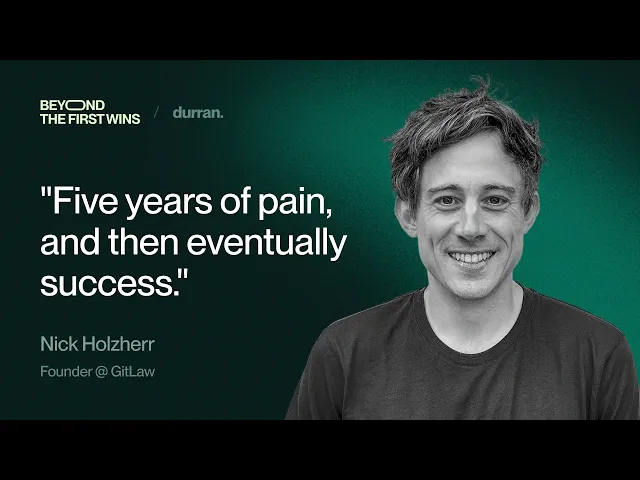
On this episode of Beyond the First Wins, we talked with Nick Holzherr, founder of GitLaw — an AI agent that creates and reviews legal contracts for businesses. Nick has been building companies for about 20 years, including Whisk, which he sold to Samsung in 2019. GitLaw came from his own pain: over two decades he calculated he'd spent well over a million pounds on legal fees, and realised that 95% of small business owners can't afford legal advice at all. It started as "Git for legal" — open-source templates with revision history and pull requests — and pivoted to AI-first when LLMs exploded mid-build.
Validate the assumptions, then build
Nick's approach to an MVP is a mix of early vision and instinct that quickly gives way to user-led insight: lots of user research, talking to users, surveys, and studying competitors to understand what people actually want. Internally, every idea runs through a flow — from discovery, to a short "concept seed" (an A4 page or less) that maps the assumptions you're making and whether they're validated, to a product requirement document you actually deliver. The questions that drive it: what are my hypotheses, which are validated and which are gut instinct, and — crucially — how reversible and critical is this decision? If something's fundamental and hard to reverse, the bar for research is far higher than for something minor you can undo. That's assumption mapping: validate the risky, unproven bets before you build, not after.
On how many users to talk to: it depends on how unique your thesis is and how much validation already exists, but Nick's rule of thumb is a minimum of around 20, ideally 50 or 100, sometimes hundreds. The signal you're looking for is the same one every researcher describes — when you can almost predict what each user will say next, you understand the requirements well enough to decide. Surveys are cheaper and faster (design it, click go, results in 24 hours) but not as rich as video interviews. And there's a modern counter to over-researching: because you can build so cheaply now, sometimes it's cheaper to ship something small, put it in front of users, and watch whether they actually engage — a small real test beating a survey. (Though in a sensitive space like legal, you can't just throw things up with security gaps.)
Honest feedback, and what product-market fit really feels like
A recurring trap: most people in your circle will tell you your idea is great because they want you to feel good — the same way it's easier for an investor to say "love it, just not investing right now" than to be honest. Nick has experimented with giving hard feedback and found people rarely thank you for it; they leave feeling like you called their baby ugly. So test it in a way that's meaningful — with people outside your circle, or the rare brutally honest peers.
As for product-market fit: Nick is blunt that true PMF — the sudden hockey stick — is rare, and most founders live a slower, harder grind. Whisk took five years of "bumps" of fit before it suddenly hit around 2017: within a year they went from two people to 30, from unprofitable to profitable, and three large companies came to them to buy. That's what true PMF feels like — money stops being the problem and people want to buy you. Getting there meant brutal cycles of cutting and growing the team, with real emotional cost. His two strengths that carried it: finding people smarter than him, and grit — sticking with ideas longer than others would. Like a flywheel, the momentum is brutally slow at first and then, if you keep going, suddenly fast.
Watch the full conversation above. If you want to validate before you build, that's the heart of how we work.
On this episode of Beyond the First Wins, we talked with Nick Holzherr, founder of GitLaw — an AI agent that creates and reviews legal contracts for businesses. Nick has been building companies for about 20 years, including Whisk, which he sold to Samsung in 2019. GitLaw came from his own pain: over two decades he calculated he'd spent well over a million pounds on legal fees, and realised that 95% of small business owners can't afford legal advice at all. It started as "Git for legal" — open-source templates with revision history and pull requests — and pivoted to AI-first when LLMs exploded mid-build.
Validate the assumptions, then build
Nick's approach to an MVP is a mix of early vision and instinct that quickly gives way to user-led insight: lots of user research, talking to users, surveys, and studying competitors to understand what people actually want. Internally, every idea runs through a flow — from discovery, to a short "concept seed" (an A4 page or less) that maps the assumptions you're making and whether they're validated, to a product requirement document you actually deliver. The questions that drive it: what are my hypotheses, which are validated and which are gut instinct, and — crucially — how reversible and critical is this decision? If something's fundamental and hard to reverse, the bar for research is far higher than for something minor you can undo. That's assumption mapping: validate the risky, unproven bets before you build, not after.
On how many users to talk to: it depends on how unique your thesis is and how much validation already exists, but Nick's rule of thumb is a minimum of around 20, ideally 50 or 100, sometimes hundreds. The signal you're looking for is the same one every researcher describes — when you can almost predict what each user will say next, you understand the requirements well enough to decide. Surveys are cheaper and faster (design it, click go, results in 24 hours) but not as rich as video interviews. And there's a modern counter to over-researching: because you can build so cheaply now, sometimes it's cheaper to ship something small, put it in front of users, and watch whether they actually engage — a small real test beating a survey. (Though in a sensitive space like legal, you can't just throw things up with security gaps.)
Honest feedback, and what product-market fit really feels like
A recurring trap: most people in your circle will tell you your idea is great because they want you to feel good — the same way it's easier for an investor to say "love it, just not investing right now" than to be honest. Nick has experimented with giving hard feedback and found people rarely thank you for it; they leave feeling like you called their baby ugly. So test it in a way that's meaningful — with people outside your circle, or the rare brutally honest peers.
As for product-market fit: Nick is blunt that true PMF — the sudden hockey stick — is rare, and most founders live a slower, harder grind. Whisk took five years of "bumps" of fit before it suddenly hit around 2017: within a year they went from two people to 30, from unprofitable to profitable, and three large companies came to them to buy. That's what true PMF feels like — money stops being the problem and people want to buy you. Getting there meant brutal cycles of cutting and growing the team, with real emotional cost. His two strengths that carried it: finding people smarter than him, and grit — sticking with ideas longer than others would. Like a flywheel, the momentum is brutally slow at first and then, if you keep going, suddenly fast.
Watch the full conversation above. If you want to validate before you build, that's the heart of how we work.
Design Process
Product Strategy
Startup
subscribe to our newsletter
subscribe to our newsletter
Get the latest articles straight in your inbox
Get the latest articles straight in your inbox
Practical product and UX insights to help SaaS teams ship with confidence before users get confused or features go unused.
Practical product and UX insights to help SaaS teams ship with confidence before users get confused or features go unused.
Product Design Studio
for growth-stage SaaS teams
© Durran 2026
Product Design Studio
for growth-stage SaaS teams
© Durran 2026
Product Design Studio
for growth-stage SaaS teams
© Durran 2026
Product Design Studio
for growth-stage SaaS teams
© Durran 2026