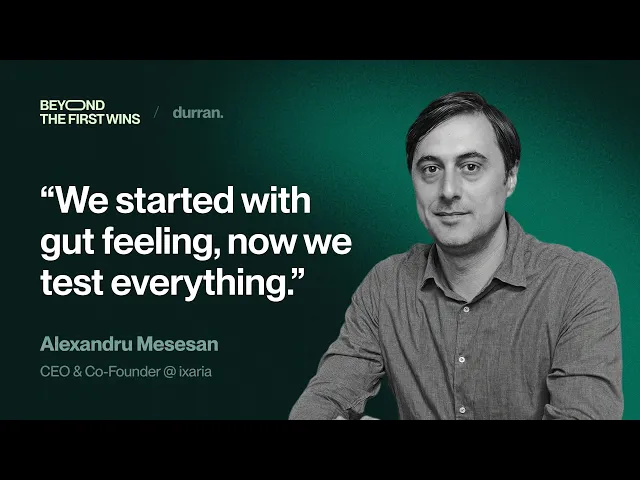
From Guesswork to Validation: How Ixaria Learned to Build for Real Users — with Alexandru Mesesan
From Guesswork to Validation: How Ixaria Learned to Build for Real Users — with Alexandru Mesesan
From Guesswork to Validation: How Ixaria Learned to Build for Real Users — with Alexandru Mesesan
On Beyond the First Wins: Ixaria's co-founder on going from a 3D services shop to a product company, the costly mistake of building the wrong UX, and learning to lead with customer interviews.
On Beyond the First Wins: Ixaria's co-founder on going from a 3D services shop to a product company, the costly mistake of building the wrong UX, and learning to lead with customer interviews.
On Beyond the First Wins: Ixaria's co-founder on going from a 3D services shop to a product company, the costly mistake of building the wrong UX, and learning to lead with customer interviews.

Daniel Andor
Daniel Andor
Daniel Andor
On this episode of Beyond the First Wins, we talked with Alex Mesesan, co-founder and CEO of Ixaria, a 3D product-configurator platform. Alex fell in love with 3D in college studying architecture, started freelancing on Elance/oDesk (which became Upwork), and grew that into a services company building browser-based 3D applications — architectural and mechanical projects, product presentations, and a lot of configurators. By 2019 he was bored of services and wanted to be part of the life of the products he built, not just their birth and maintenance — and the only way to find out how people actually used them was to build his own product. He teamed up with Victor, a strong Angular developer he'd hired, and they turned years of custom configurator work into a platform: make it easy to build any kind of product configurator.
The costly UX mistake
Their product has two sides: the platform (a complex web app where you upload 3D models, set up materials, lighting, attributes, and layouts) and the output — the published experience the end customer actually uses, which is a completely different UX aimed at a different person. Alex's most candid admission: one of their biggest mistakes was pouring most of their effort into the platform and the platform's UX, rather than the end product's UX — the thing their customers' customers actually see. They got the platform working perfectly while the end result "wasn't there yet." Looking back, he'd have done it the other way around.
Letting the customer redraw the strategy
The whole evolution of Ixaria has been driven by understanding customers better — Alex reckons more than a thousand conversations. They started believing a configurator alone could increase conversion and sales, and learned the hard way that it can't: if it's hard to find, not a satisfying experience, or aimed at the wrong buyer, it won't move the needle. (One fast-signed deal with a seller of very cheap furniture taught them their tool isn't for everyone — the wrong customer can actually end up selling less.) So they're now shifting to control the full product-page experience, not just a configurator sitting at the bottom of a page nobody scrolls to. Their role in the partnership, as Alex frames it, is to help clients sell more.
How they build now
For new ideas, Ixaria now starts by verifying the problem is real and the solution is good — through interviews, currently with people across Europe to avoid cultural bias. Once that's validated, they move to drafts and Figma sketches to check direction, and from there it's an iterative test-and-learn process rather than the gut-feeling approach of the early days. On the classic founder question — how many interviews are enough? — Alex's answer matches the cliché for a reason: when you keep hearing the same answers and can predict what people will say, you've got enough. Roughly five to ten interviews give a rough confirmation, and that works because you already know your ICP well enough to pre-filter who you talk to. His parting advice to his earlier self and other founders: read more and apply what you read — Lean Startup, The Mom Test, and Cagan's Inspired among them — and build a strong daily routine.
Watch the full conversation above. If you're shifting from guesswork to validation, that's exactly how we work.
On this episode of Beyond the First Wins, we talked with Alex Mesesan, co-founder and CEO of Ixaria, a 3D product-configurator platform. Alex fell in love with 3D in college studying architecture, started freelancing on Elance/oDesk (which became Upwork), and grew that into a services company building browser-based 3D applications — architectural and mechanical projects, product presentations, and a lot of configurators. By 2019 he was bored of services and wanted to be part of the life of the products he built, not just their birth and maintenance — and the only way to find out how people actually used them was to build his own product. He teamed up with Victor, a strong Angular developer he'd hired, and they turned years of custom configurator work into a platform: make it easy to build any kind of product configurator.
The costly UX mistake
Their product has two sides: the platform (a complex web app where you upload 3D models, set up materials, lighting, attributes, and layouts) and the output — the published experience the end customer actually uses, which is a completely different UX aimed at a different person. Alex's most candid admission: one of their biggest mistakes was pouring most of their effort into the platform and the platform's UX, rather than the end product's UX — the thing their customers' customers actually see. They got the platform working perfectly while the end result "wasn't there yet." Looking back, he'd have done it the other way around.
Letting the customer redraw the strategy
The whole evolution of Ixaria has been driven by understanding customers better — Alex reckons more than a thousand conversations. They started believing a configurator alone could increase conversion and sales, and learned the hard way that it can't: if it's hard to find, not a satisfying experience, or aimed at the wrong buyer, it won't move the needle. (One fast-signed deal with a seller of very cheap furniture taught them their tool isn't for everyone — the wrong customer can actually end up selling less.) So they're now shifting to control the full product-page experience, not just a configurator sitting at the bottom of a page nobody scrolls to. Their role in the partnership, as Alex frames it, is to help clients sell more.
How they build now
For new ideas, Ixaria now starts by verifying the problem is real and the solution is good — through interviews, currently with people across Europe to avoid cultural bias. Once that's validated, they move to drafts and Figma sketches to check direction, and from there it's an iterative test-and-learn process rather than the gut-feeling approach of the early days. On the classic founder question — how many interviews are enough? — Alex's answer matches the cliché for a reason: when you keep hearing the same answers and can predict what people will say, you've got enough. Roughly five to ten interviews give a rough confirmation, and that works because you already know your ICP well enough to pre-filter who you talk to. His parting advice to his earlier self and other founders: read more and apply what you read — Lean Startup, The Mom Test, and Cagan's Inspired among them — and build a strong daily routine.
Watch the full conversation above. If you're shifting from guesswork to validation, that's exactly how we work.
Design Process
Product Strategy
Startup
subscribe to our newsletter
subscribe to our newsletter
Get the latest articles straight in your inbox
Get the latest articles straight in your inbox
Practical product and UX insights to help SaaS teams ship with confidence before users get confused or features go unused.
Practical product and UX insights to help SaaS teams ship with confidence before users get confused or features go unused.
Product Design Studio
for growth-stage SaaS teams
© Durran 2026
Product Design Studio
for growth-stage SaaS teams
© Durran 2026
Product Design Studio
for growth-stage SaaS teams
© Durran 2026
Product Design Studio
for growth-stage SaaS teams
© Durran 2026