The State of Product UX 2026
The State of Product UX 2026
The State of Product UX 2026
61% of Early-Stage Founders are Holding Their Product Back
61% of Early-Stage Founders are Holding Their Product Back
61% of Early-Stage Founders are Holding Their Product Back

Daniel Andor
Daniel Andor
Daniel Andor
Key highlights:
Founders are the biggest bottleneck: 61% refuse to let go of UX strategy until it’s too late to scale
Dumping UX on your PM at the seed stage is a scaling error (yet 71% do it anyway)
Dedicated design leadership was nonexistent among our series A respondents
Copywriting is the top AI use case at 67%, but usability testing sits at only 13%
Romanian founders are twice as likely to see no clear AI impact compared to their global peers (39% vs 18%)
Strategic recommendations: don't wait for series B to hire a design lead
In the early days of a startup, the user experience is a direct reflection of the founder’s brain. It’s often built on intuition, late-night wireframes, and a singular vision. It’s messy, no doubt, but it is fast. At this stage, the product feels like an extension of a single person's intent or idea. The founder knows every edge case because they likely discovered it themselves while building the MVP.
However, as you move from finding a market to scaling a product, that intuition begins to fail, and it’s suddenly no longer enough. Our 2026 state of product UX report has revealed a critical structural flaw in the growth map of modern startups. Data from our survey of founders and product leaders shows that, while engineering and sales teams are doubling in size during the seed and series A stages, the design seat at the executive table remains empty until the product reaches a breaking point.
Founders are the biggest bottleneck: 61% refuse to let go of UX strategy until it’s too late to scale
In the pre-seed and bootstrapped phases, UX is not a department, it’s just part of the founder’s portfolio of skills and tasks. Our research shows that 61% of UX strategy in the early stages is driven directly by the founder. At this stage, the UX lead is usually the person with the most equity.
Up to the seed stage, the CTO or the founder is often the one wearing the product and UX hat, trying to balance technical feasibility with user needs. It’s a time of high control, but extremely low scalability, as the founder’s bandwidth is stretched thin. The product is a bespoke build, and every new feature is a direct line from the founder's mind to the user's screen, with no outside intervention.
In this early stage, the founder has to wear many hats due to limited resources, as it’s mostly a time of testing out the market, validating ideas, and analyzing the competition, so a dedicated product designer is not really a priority, yet.
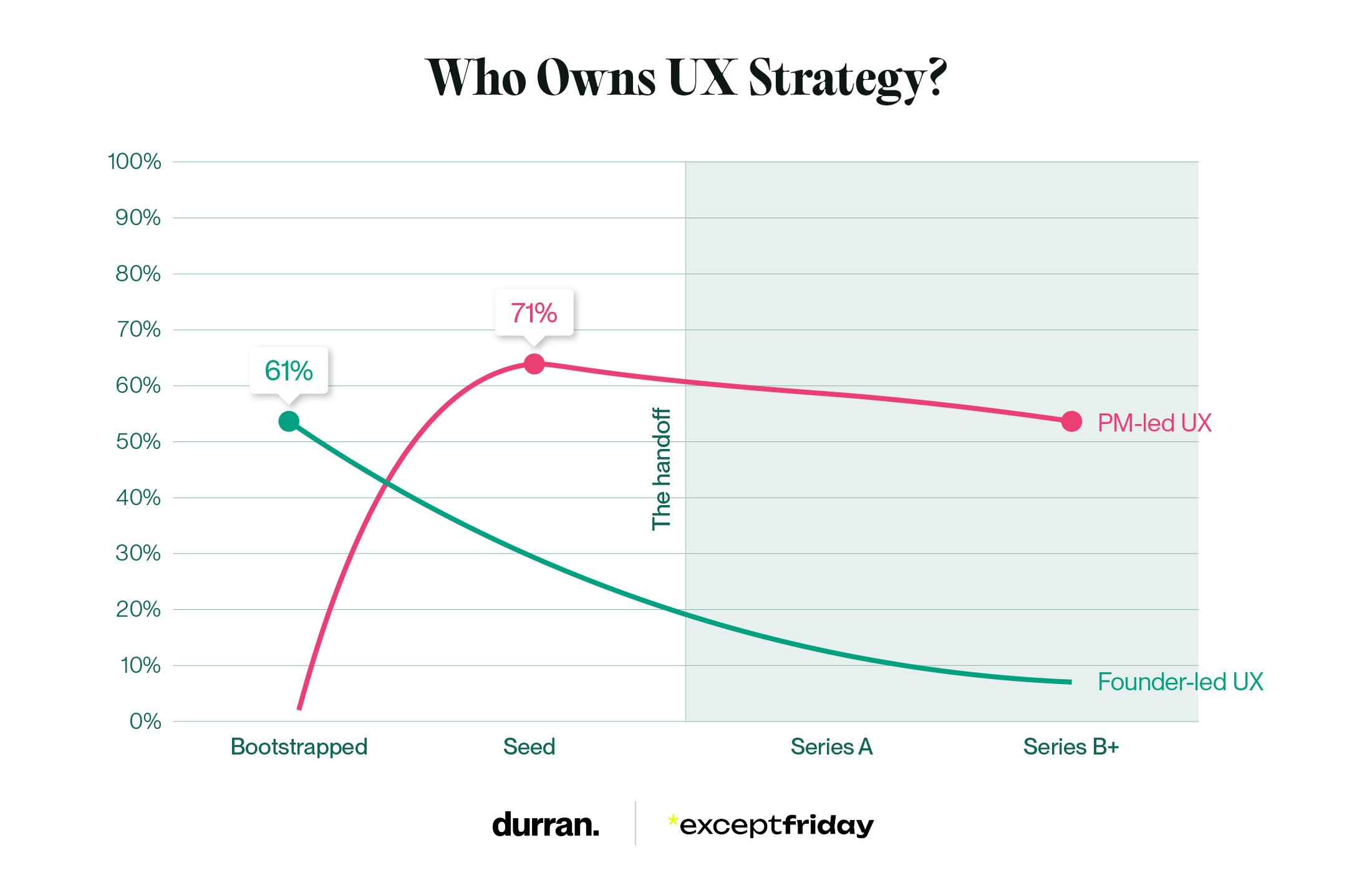
Dumping UX on your PM at the seed stage is a scaling error (yet 71% do it anyway)
The shift begins at the seed stage, and it is more of a collision than a gradual hand-off. As the team grows, the founder can no longer oversee every pixel or interview every user. Consequently, responsibility for the user experience shifts dramatically to product managers.
This is a tricky inflection point. While PMs are excellent at process, roadmap management, and delivery, their primary KPI is often shipping. In the rush to meet the roadmap promised to seed investors, UX often transitions from a strategic advantage to a checklist item and not much more. At this point, product development often becomes more about hitting deadlines than making sure the user experience actually makes sense. Without a dedicated design strategist, the product begins to lose its cohesive soul and starts becoming a collection of disconnected features.
Dedicated design leadership was nonexistent among our series A respondents
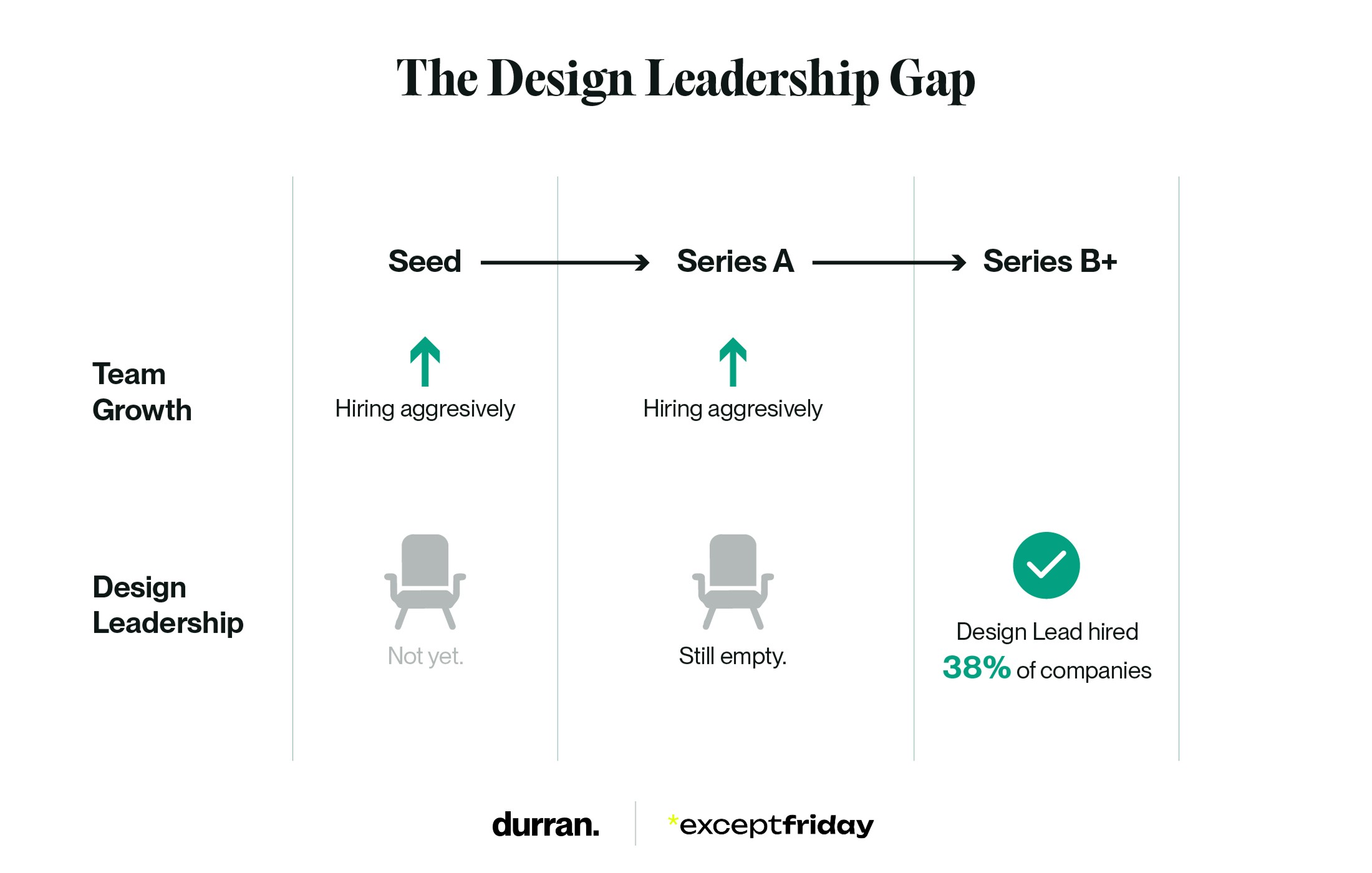
This is where our data revealed the most startling insight. While startups are flush with series A capital and hiring aggressively in every other department, our study found that 0% of seed and series A companies had a dedicated, in-house design lead or VP of product design.
This is what we’ll call ‘the design wall.’ Startups are scaling their user base and their codebases at 3x speed, but they are doing so without a dedicated architect to steer the ship in the right direction. It is not until series B that we see a design seat appear at the table, with 38% of companies finally hiring dedicated design leadership.
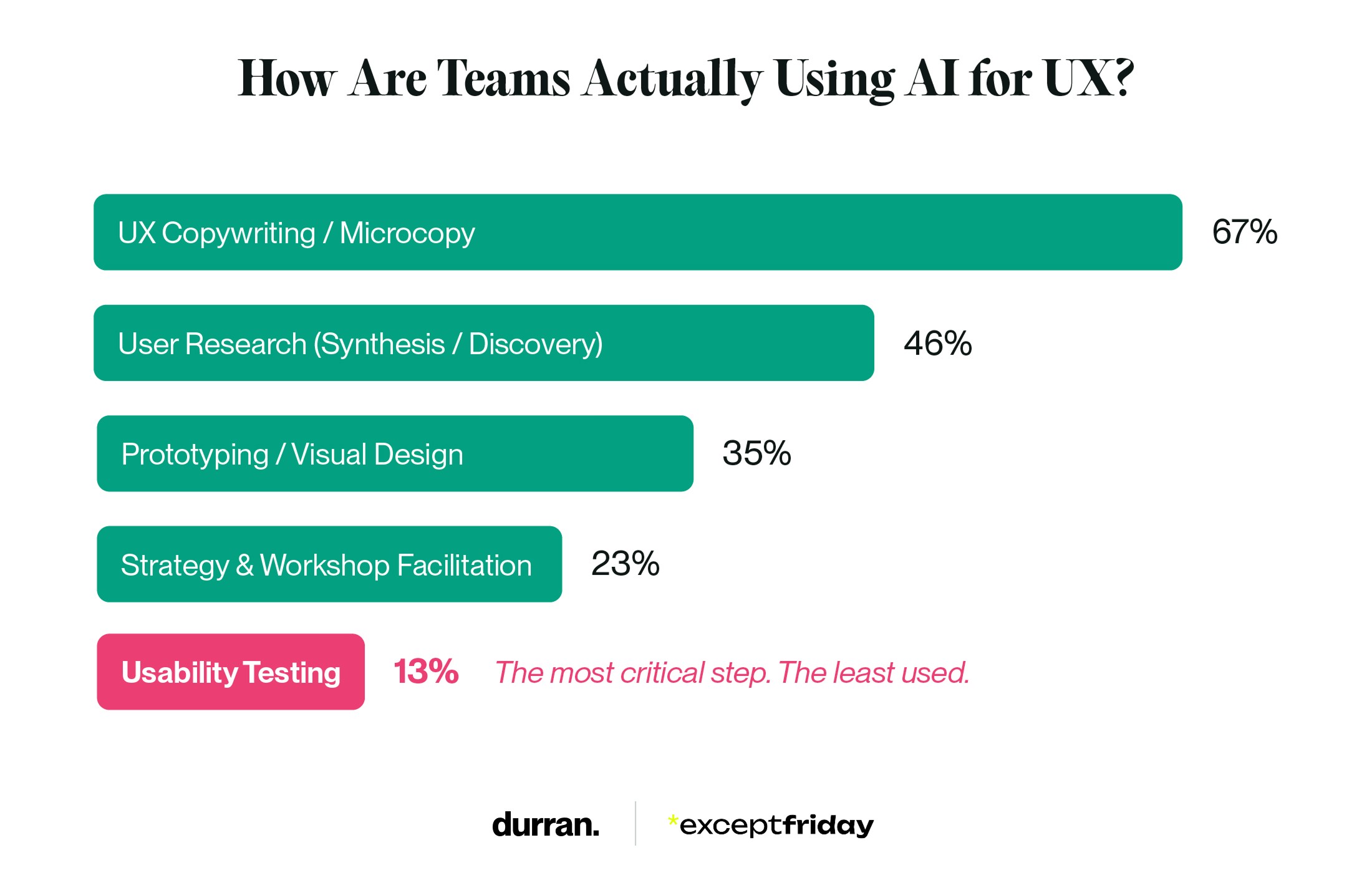
Copywriting is the top AI use case at 67%, but usability testing sits at only 13%
Our survey shows that many founders hope AI will be the thing to bridge this design leadership gap. The logic is tempting: if we do not have a designer, we will just use AI to generate the UI. However, our data suggests AI is currently being used to build faster, not necessarily better.
The top use case for AI in UX today is copywriting (67%), followed by user research and prototyping. These are output tasks that help get things out the door. Meanwhile, the most critical strategic task—usability testing—sits at the very bottom of the list, with only 13% adoption.
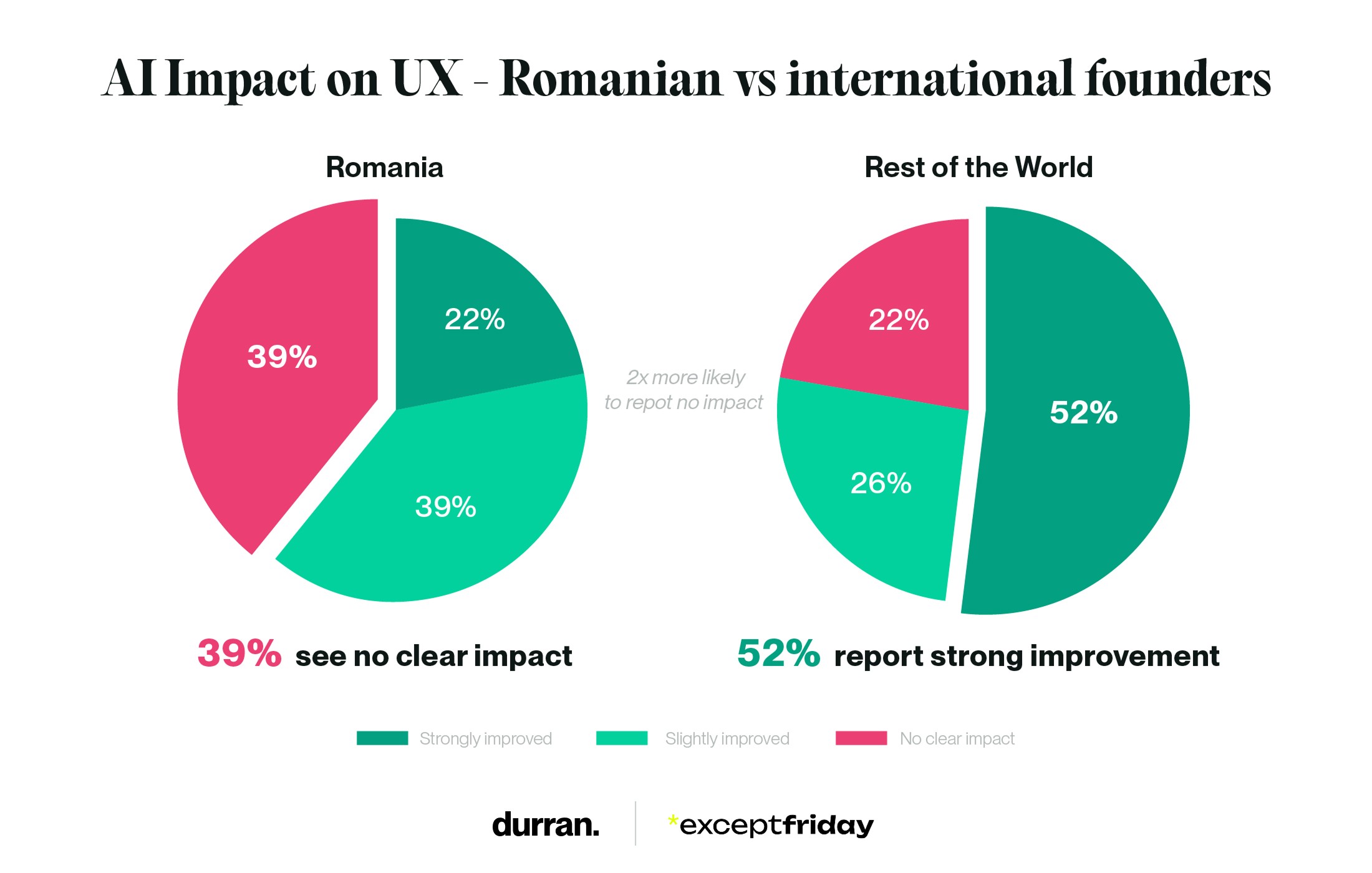
Romanian founders are twice as likely to see no clear AI impact compared to their global peers (39% vs 18%)
While the global narrative is one of AI-driven transformation—with 52% of international founders reporting a ‘strong improvement’ in UX—local leaders are far more reserved. In Romania, only 22% report a strong improvement, while 39% explicitly state that AI has had ‘no clear impact’ on their product’s user experience yet.
Unlike the hype-driven cycles often found in larger tech hubs, Romanian founders remain grounded in the reality that UX is a human-centric strategy. Their skepticism suggests a hesitation to disrupt existing workflows for tools that haven't yet proven their worth or ease of use. While a tool can generate a screen, it cannot define a product’s direction, and for many, the effort required to master these new AI workflows doesn't yet outweigh the perceived benefits.
Strategic recommendations: don't wait for series B to hire a design lead
The design wall is the silent killer of product-led growth. It manifests as a sudden drop in retention or an unexplainable friction in onboarding that occurs right when you should be accelerating. Waiting until series B to build out a dedicated design leadership team is a high-risk strategy. It means you are essentially building a skyscraper without an architect and hoping to fix the foundation once the tenth floor is finished.
Look for fractional leadership: If you cannot justify a full-time VP of design at series A, look for fractional leadership to maintain the integrity of the user experience.
Use AI for validation: Shift your AI focus and use tools to analyze user feedback and synthesize testing sessions, rather than just churning out more microcopy.
Perform regular audits: If you are between seed and series B, perform a UX audit every quarter to identify where features are diverging from the original vision.
Want to see how your startup benchmarks against the industry? Download the full dataset on AI adoption, team structures, and the top UX challenges facing founders this year.
Methodology
The findings in this article are based on a quantitative online survey of startup founders and product leaders across Romania, the United Kingdom, Germany, the United States, and France, conducted in December 2025.
Key highlights:
Founders are the biggest bottleneck: 61% refuse to let go of UX strategy until it’s too late to scale
Dumping UX on your PM at the seed stage is a scaling error (yet 71% do it anyway)
Dedicated design leadership was nonexistent among our series A respondents
Copywriting is the top AI use case at 67%, but usability testing sits at only 13%
Romanian founders are twice as likely to see no clear AI impact compared to their global peers (39% vs 18%)
Strategic recommendations: don't wait for series B to hire a design lead
In the early days of a startup, the user experience is a direct reflection of the founder’s brain. It’s often built on intuition, late-night wireframes, and a singular vision. It’s messy, no doubt, but it is fast. At this stage, the product feels like an extension of a single person's intent or idea. The founder knows every edge case because they likely discovered it themselves while building the MVP.
However, as you move from finding a market to scaling a product, that intuition begins to fail, and it’s suddenly no longer enough. Our 2026 state of product UX report has revealed a critical structural flaw in the growth map of modern startups. Data from our survey of founders and product leaders shows that, while engineering and sales teams are doubling in size during the seed and series A stages, the design seat at the executive table remains empty until the product reaches a breaking point.
Founders are the biggest bottleneck: 61% refuse to let go of UX strategy until it’s too late to scale
In the pre-seed and bootstrapped phases, UX is not a department, it’s just part of the founder’s portfolio of skills and tasks. Our research shows that 61% of UX strategy in the early stages is driven directly by the founder. At this stage, the UX lead is usually the person with the most equity.
Up to the seed stage, the CTO or the founder is often the one wearing the product and UX hat, trying to balance technical feasibility with user needs. It’s a time of high control, but extremely low scalability, as the founder’s bandwidth is stretched thin. The product is a bespoke build, and every new feature is a direct line from the founder's mind to the user's screen, with no outside intervention.
In this early stage, the founder has to wear many hats due to limited resources, as it’s mostly a time of testing out the market, validating ideas, and analyzing the competition, so a dedicated product designer is not really a priority, yet.
Dumping UX on your PM at the seed stage is a scaling error (yet 71% do it anyway)
The shift begins at the seed stage, and it is more of a collision than a gradual hand-off. As the team grows, the founder can no longer oversee every pixel or interview every user. Consequently, responsibility for the user experience shifts dramatically to product managers.
This is a tricky inflection point. While PMs are excellent at process, roadmap management, and delivery, their primary KPI is often shipping. In the rush to meet the roadmap promised to seed investors, UX often transitions from a strategic advantage to a checklist item and not much more. At this point, product development often becomes more about hitting deadlines than making sure the user experience actually makes sense. Without a dedicated design strategist, the product begins to lose its cohesive soul and starts becoming a collection of disconnected features.
Dedicated design leadership was nonexistent among our series A respondents
This is where our data revealed the most startling insight. While startups are flush with series A capital and hiring aggressively in every other department, our study found that 0% of seed and series A companies had a dedicated, in-house design lead or VP of product design.
This is what we’ll call ‘the design wall.’ Startups are scaling their user base and their codebases at 3x speed, but they are doing so without a dedicated architect to steer the ship in the right direction. It is not until series B that we see a design seat appear at the table, with 38% of companies finally hiring dedicated design leadership.
Copywriting is the top AI use case at 67%, but usability testing sits at only 13%
Our survey shows that many founders hope AI will be the thing to bridge this design leadership gap. The logic is tempting: if we do not have a designer, we will just use AI to generate the UI. However, our data suggests AI is currently being used to build faster, not necessarily better.
The top use case for AI in UX today is copywriting (67%), followed by user research and prototyping. These are output tasks that help get things out the door. Meanwhile, the most critical strategic task—usability testing—sits at the very bottom of the list, with only 13% adoption.
Romanian founders are twice as likely to see no clear AI impact compared to their global peers (39% vs 18%)
While the global narrative is one of AI-driven transformation—with 52% of international founders reporting a ‘strong improvement’ in UX—local leaders are far more reserved. In Romania, only 22% report a strong improvement, while 39% explicitly state that AI has had ‘no clear impact’ on their product’s user experience yet.
Unlike the hype-driven cycles often found in larger tech hubs, Romanian founders remain grounded in the reality that UX is a human-centric strategy. Their skepticism suggests a hesitation to disrupt existing workflows for tools that haven't yet proven their worth or ease of use. While a tool can generate a screen, it cannot define a product’s direction, and for many, the effort required to master these new AI workflows doesn't yet outweigh the perceived benefits.
Strategic recommendations: don't wait for series B to hire a design lead
The design wall is the silent killer of product-led growth. It manifests as a sudden drop in retention or an unexplainable friction in onboarding that occurs right when you should be accelerating. Waiting until series B to build out a dedicated design leadership team is a high-risk strategy. It means you are essentially building a skyscraper without an architect and hoping to fix the foundation once the tenth floor is finished.
Look for fractional leadership: If you cannot justify a full-time VP of design at series A, look for fractional leadership to maintain the integrity of the user experience.
Use AI for validation: Shift your AI focus and use tools to analyze user feedback and synthesize testing sessions, rather than just churning out more microcopy.
Perform regular audits: If you are between seed and series B, perform a UX audit every quarter to identify where features are diverging from the original vision.
Want to see how your startup benchmarks against the industry? Download the full dataset on AI adoption, team structures, and the top UX challenges facing founders this year.
Methodology
The findings in this article are based on a quantitative online survey of startup founders and product leaders across Romania, the United Kingdom, Germany, the United States, and France, conducted in December 2025.
Design Process
Product Strategy
Startup
subscribe to our newsletter
subscribe to our newsletter
Get the latest articles straight in your inbox
Get the latest articles straight in your inbox
Practical product and UX insights to help SaaS teams ship with confidence before users get confused or features go unused.
Practical product and UX insights to help SaaS teams ship with confidence before users get confused or features go unused.
Product Design Studio
for growth-stage SaaS teams
© Durran 2026
Product Design Studio
for growth-stage SaaS teams
© Durran 2026
Product Design Studio
for growth-stage SaaS teams
© Durran 2026
Product Design Studio
for growth-stage SaaS teams
© Durran 2026